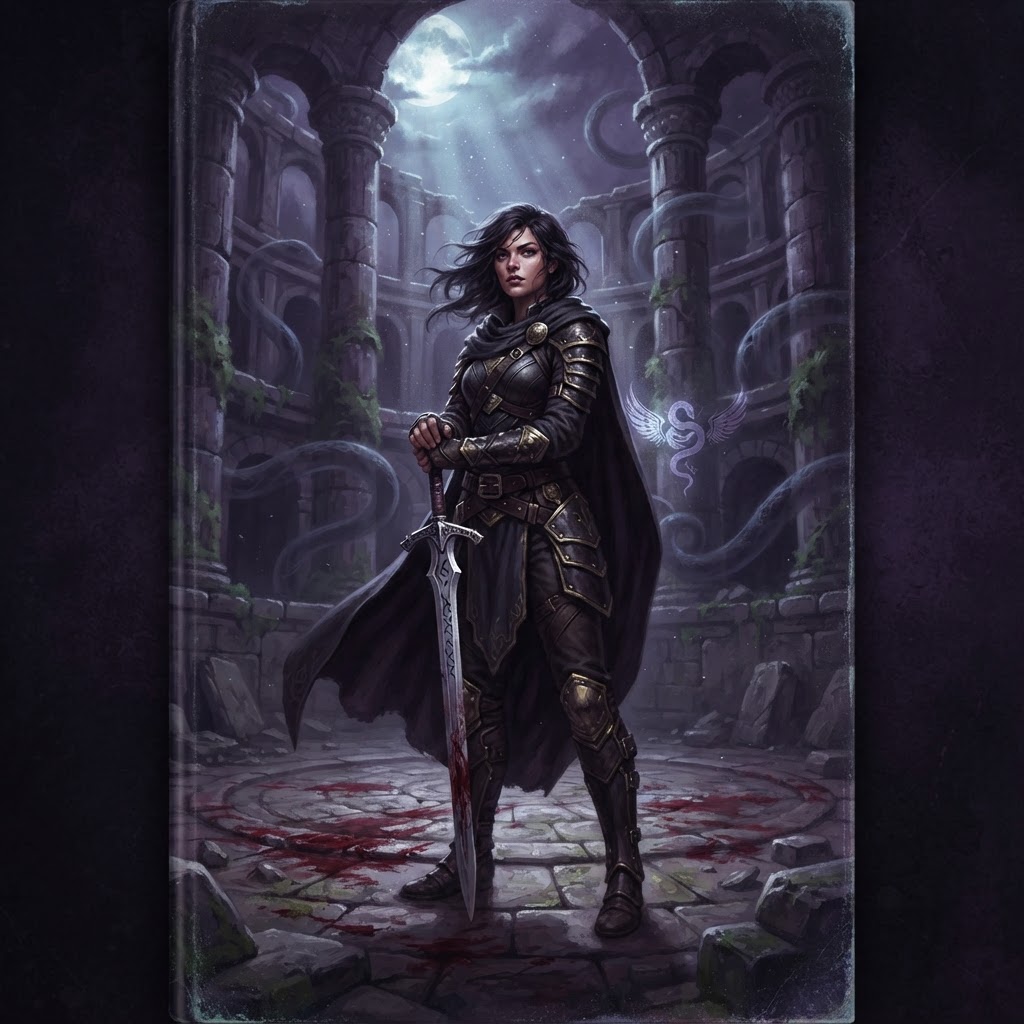
The Sunshine Girl Was Never Actually Fine
Mische has been a supporting character for two books, cheerful, chatty, relentlessly warm, the friend who lightens every room she enters. The Songbird and the Heart of Stone reveals what that cheer was covering, and it is not pretty.
Mische was a devoted acolyte of Atroxus, the sun god, before she was forcibly Turned into a vampire. In that moment she lost her home, her humanity, and (most devastating of all for someone whose entire identity was built on faith) the love of the god she had given her life to. The sunny disposition everyone has spent two books enjoying is the coping mechanism of a woman who believes she is fundamentally damned.
Now she's been sentenced to death for killing the vampire prince who Turned her. And redemption, the only thing she has ever wanted, is impossible.
What It's About
Mische is saved from execution by Asar, the bastard prince of the House of Shadow, a necromancer with a brutal past written across his body in scars and a reputation as the Wraith Warden. He does not save her out of kindness. He saves her because he needs her for a mission that is arguably worse than dying: a descent into the underworld to resurrect the god of death himself.
Then Atroxus makes contact. Her sun god, silent for years, gives Mische a command. Help Asar complete his mission, and then betray him by killing the god he resurrects. Do this, and she will be forgiven. Do this, and she can go home.
The rest of the novel is Mische and Asar traveling deeper into Morthryn, a sentient god-touched prison structured in descending levels, each one designed to strip something away from whoever enters. And every step Mische takes toward her redemption is a step toward the betrayal of a man she is falling in love with.
Why It's the Best in the Series
Morthryn is a triumph of setting. A malevolent, semi-conscious prison built in tiers, each level extracting a different toll. It gives the book a structure (descent, level by level) that generates momentum while allowing Broadbent to stage each stage as its own set piece. It is the most inventive location she has built.
Mische's arc is the emotional core of the entire series. The gap between the persona she performs and the self-loathing underneath is rendered with painful precision. Her relationship with faith (the specific grief of having loved a god who stopped loving you back) is the most thematically ambitious material Broadbent has attempted, and she handles it with real seriousness.
Asar is the standout love interest. Broody exiled necromancer with a wolfhound and a devastating capacity for gentleness, Asar functions as the perfect counterweight to Mische's performed brightness. He sees through her immediately, and rather than pushing, he simply refuses to accept the performance. Their dynamic (sunshine and shadow, in the most literal possible terms) earns every beat.
The betrayal premise is agonizing. The reader knows from early on what Mische has been ordered to do. Every tender scene between them is shadowed by it. Broadbent sustains that dread for four hundred pages without releasing the pressure, and the payoff is worth it.
Where It Struggles
The descent structure, while effective, becomes repetitive in the middle levels. Two or three of Morthryn's tiers blur together, and the trials start to feel like obstacles rather than revelations.
Readers attached to Oraya and Raihn will find the transition jarring. This is a new duet with a new couple, a new house, and a largely new supporting cast. The connective tissue to the Nightborn Duet is thinner than some expected.
The mythology load is heavy. Gods, houses, underworld cosmology, necromantic mechanics, Broadbent asks the reader to hold a great deal, and the exposition occasionally interrupts scenes that were working better without it.
The Velvet Coven Verdict
The Songbird and the Heart of Stone is Carissa Broadbent's best novel. It has the tightest thematic spine of anything in Nyaxia (faith, self-forgiveness, and the difference between being redeemed and being seen) and it commits to a genuinely dark premise without flinching from it.
The comparison the publisher reaches for is A Court of Thorns and Roses meets Dante's Inferno, and for once the marketing is accurate. It's a descent narrative, a theological argument, and a love story about two people who have both decided they don't deserve one.
If you only read one book in this series, make it this one. Then immediately read the next one, because the ending will not permit anything else.
Content note: Depicts self-harm, religious trauma, and non-consensual transformation.
Quick Reference
- Author: Carissa Broadbent
- Published: 2024 (Bramble)
- Series: Crowns of Nyaxia, Book 3: Shadowborn Duet opener
- Setting: Obitraes, House of Shadow, Morthryn, the underworld
- Tropes: Sunshine and shadow, necromancer, forced proximity, betrayal, descent, religious trauma
- Spice level: 4/5, explicit, slow burn
- Status: NYT Bestseller