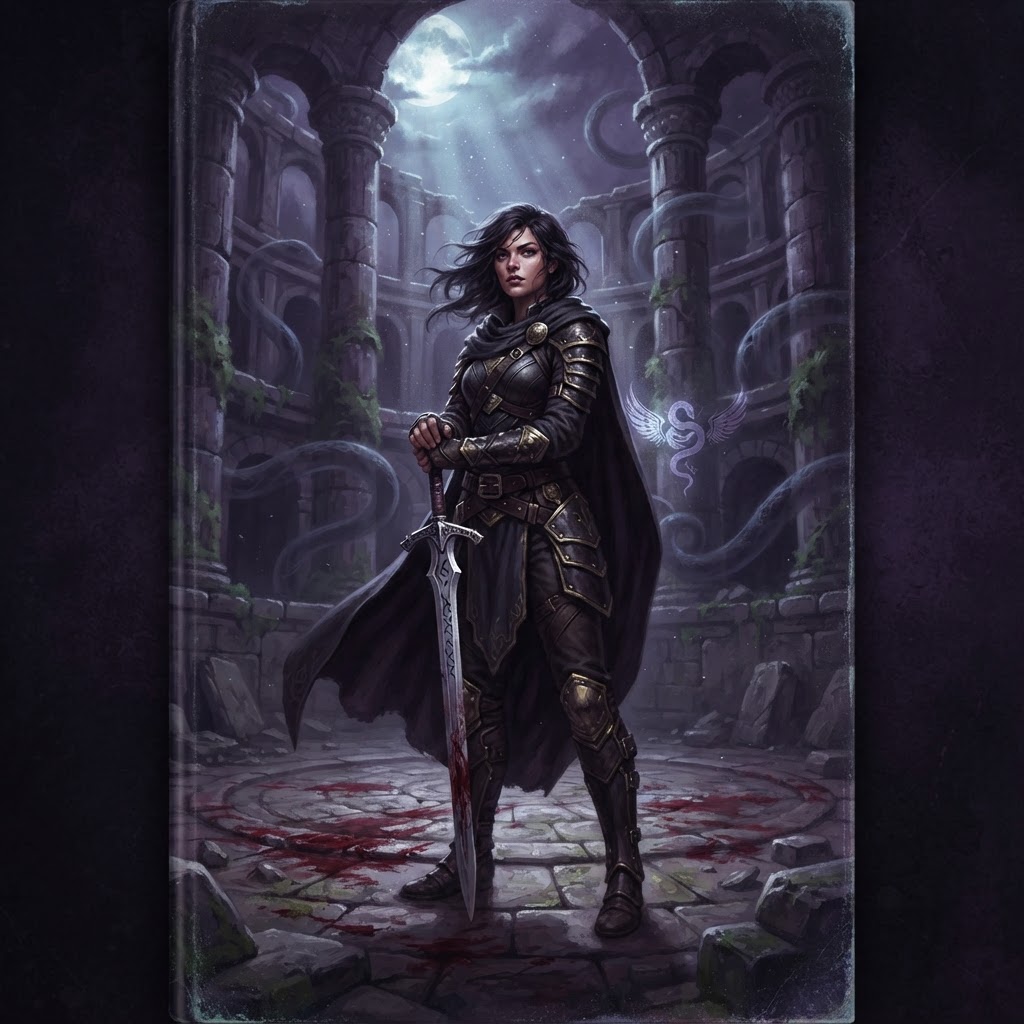
After the Sacrifice
The Songbird and the Heart of Stone ended with a choice that broke the world.
Mische made the ultimate sacrifice to save the people she loved, and the consequence was eternal night: the sun extinguished, the mortal realm plunged into permanent darkness, the balance between the living and the dead thrown into collapse. Asar, imprisoned by the gods and consumed by a grief that has calcified into vengeance, wants one thing: to find her.
When a goddess offers them both a path back (to redemption, to divinity, and to each other) they take it. The price is a mission to seize the power of the god of death so that Asar can do the impossible and ascend to true godhood.
What Works
The last forty percent is spectacular. Once the Bloodborn enter the narrative and the divine war moves from threat to reality, The Fallen and the Kiss of Dusk becomes the most propulsive book Broadbent has written. The set pieces are enormous, the stakes are cosmic, and the emotional payoffs (years in the building) land with force.
Asar's POV chapters deepen him considerably. Book three kept him at arm's length by necessity; this one lives inside his head, and what's there is more damaged and more tender than the Wraith Warden persona suggested. His conception of love (wanting to become the darkness so that Mische always has somewhere to hide) is one of the most striking romantic ideas in the series.
The thematic throughline is genuinely mature. This is a book about grief and about the specific courage required to keep living after loss. Broadbent frames the real sacrifice not as dying for someone but as choosing to survive them, and the novel earns that argument rather than asserting it.
The world expands correctly. The introduction of Bloodborn elements sets up the final duet without feeling like a commercial for the next book.
Where It Struggles
We have to be honest: the first half is a slog.
The opening act (Mische in a ghostly, in-between state, Asar imprisoned and raging) separates the couple whose dynamic powered book three, and the novel does not adequately compensate. The yearning is well-written but static. Broadbent spends a great deal of page count establishing a situation rather than developing it, and readers who tore through The Songbird and the Heart of Stone will find themselves checking their progress bar.
The dual-POV structure, which should solve this, instead diffuses it. Neither Mische nor Asar has enough forward agency in the early sections for their alternating perspectives to build momentum.
The divine cosmology reaches a density here that occasionally becomes opaque. The rules governing ascension, the underworld's structure, and the gods' constraints require close attention, and Broadbent doesn't always make that attention rewarding.
And the resolution to Asar's ascension arc, while emotionally satisfying, sidesteps some of the harder implications the setup raised.
The Velvet Coven Verdict
The Fallen and the Kiss of Dusk is the most divisive book in the Crowns of Nyaxia series, and the split is not about quality. It's about patience. Readers who push through the first half find one of the strongest finales Broadbent has written. Readers who don't will wonder what everyone is talking about.
We land on the positive side, with a caveat. Mische and Asar's conclusion is worthy of them. The Shadowborn Duet, taken as a single 1,200-page unit, is the emotional peak of this world. But book four needed an editor willing to cut a hundred and fifty pages from its opening act, and it didn't get one.
Stick with it to the Bloodborn. Everything after that is worth the wait.
Quick Reference
- Author: Carissa Broadbent
- Published: 2025 (Bramble)
- Series: Crowns of Nyaxia, Book 4: Shadowborn Duet finale
- Setting: Obitraes, the underworld, the mortal realm in eternal night
- Tropes: Grief, resurrection, ascension, reunion, divine war, sacrifice
- Spice level: 4/5, explicit
- Status: NYT Bestseller